
If you have seen an address written as 192.168.1.0/24, you have met CIDR notation and the idea of a subnet. These concepts sound technical, but the core idea is simple: they describe how a block of IP addresses is divided up. Here is a beginner-friendly explanation.
What is a subnet?
A subnet (short for sub-network) is a slice of a larger network. Splitting a big network into smaller ones — subnetting — keeps traffic organized, improves performance, and adds a layer of control.
Think of a large office building. Rather than one giant open floor, it is divided into departments. Each department is a subnet: part of the same building, but with its own clearly defined space.
Network part vs host part
Every IP address has two parts:
- The network part identifies which network the address belongs to.
- The host part identifies a specific device on that network.
A subnet mask marks where the split falls. For example, the mask 255.255.255.0 says "the first three numbers are the network, the last one is the host."
Where CIDR notation comes in
Writing out full subnet masks is clunky, so CIDR (Classless Inter-Domain Routing) notation shortens it. You write the address, a slash, and the number of network bits:
192.168.1.0/24
The /24 means the first 24 bits are the network part. The remaining 8 bits are for hosts, which gives 256 addresses (254 usable, since one is the network address and one is the broadcast address).
Reading the numbers
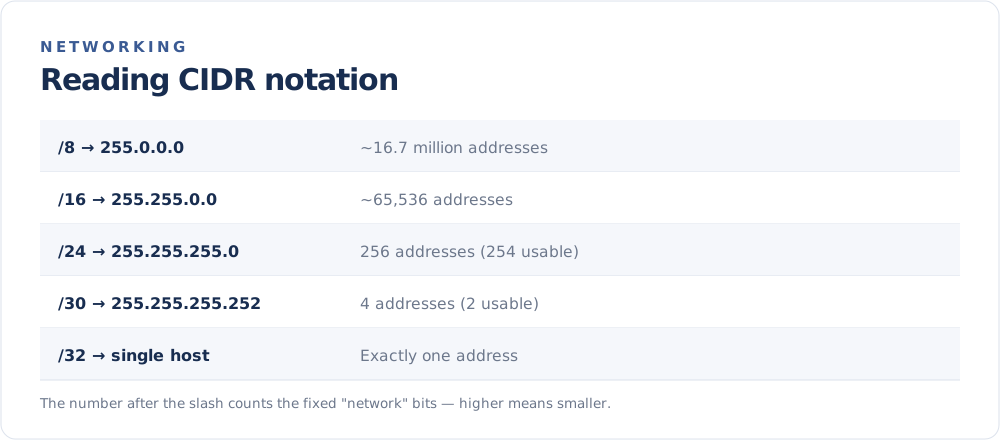
The rule of thumb: the bigger the slash number, the smaller the network.
/8→ about 16.7 million addresses (a very large block)./16→ about 65,536 addresses./24→ 256 addresses (a typical home or small-office subnet)./30→ 4 addresses (just 2 usable — handy for point-to-point links)./32→ a single, specific address.
Why this matters to you
For everyday internet use, you never need to calculate subnets. But the concepts explain a lot:
- Your home network is usually a
/24, which is why devices share the first three numbers (like192.168.1.x). See Public vs Private IP Addresses. - Firewalls and access rules often target ranges using CIDR, like allowing
203.0.113.0/24. - Network administrators use subnetting to separate departments, guests, and servers.
The takeaway
A subnet is a defined block of addresses, and CIDR notation is the shorthand for describing it. Once you read the slash as "how many bits are locked to the network," the rest falls into place. Curious about your own public address? See it on the FindMyIP home page.